




The AI Video Drama Frontier: 10 Notable Works to Know Now, Centered on China
The AI Video Drama Frontier: 10 Notable Works to Know Now, Centered on China
Videos made with generative AI are beginning to move beyond short demos into the realm of serialized drama. China’s vertical short dramas and minute-long “micro-dramas” are moving especially fast. The range of subjects now spans mythology, history, science fiction, and family drama, while state media and major video platforms continue to release experimental works one after another.
Here are 10 works—primarily announced since 2024—that show where AI video drama stands today. Even productions described as “AI dramas” differ: some generate all visuals with AI, some combine live actors with AI imagery, and others use AI only for parts of the process, such as scriptwriting or art direction. This article notes those differences wherever possible.
1. Chinese Mythology (中国神话) — China’s first “end-to-end AI” micro-drama
A six-episode series jointly produced by a China Central Television (CCTV) affiliate and a Tsinghua University research team, released in March 2024. Drawing on Chinese mythology, it depicts a visual world connecting the past, present, and future.
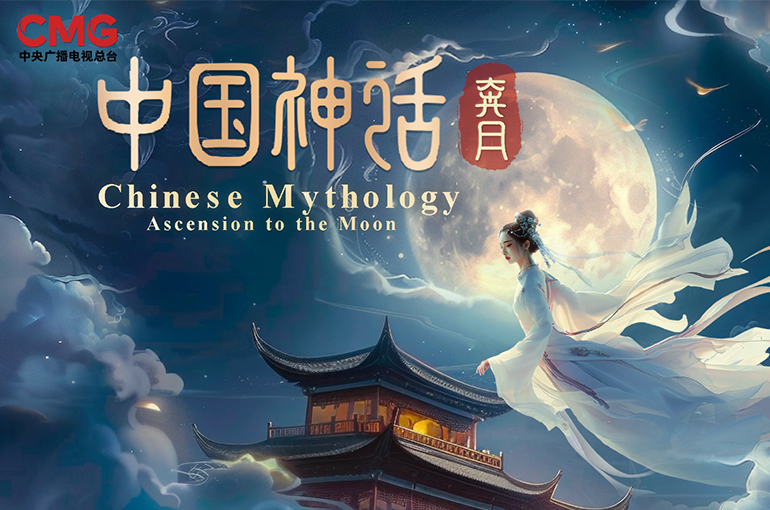
“Chang’e Flies to the Moon” from Chinese Mythology. Image: from Yicai Global and CMG’s official introduction.
What stands out is its use of AI across nearly the entire production process, including art direction, storyboards, video, audio, and music. Reported as China’s first end-to-end AI micro-drama, it is said to have cut production costs dramatically compared with conventional methods. It is an essential starting point for understanding China’s current AI-drama boom.
2. Sanxingdui: Future Apocalypse — Blending ancient civilization and science fiction
A 13-episode series of three- to four-minute installments announced in July 2024 by Douyin, China’s version of TikTok, and film company Bona Film Group. The project combines the enigmatic Sanxingdui archaeological site with a futuristic science-fiction world and was also presented at a museum cultural-relic exhibition.
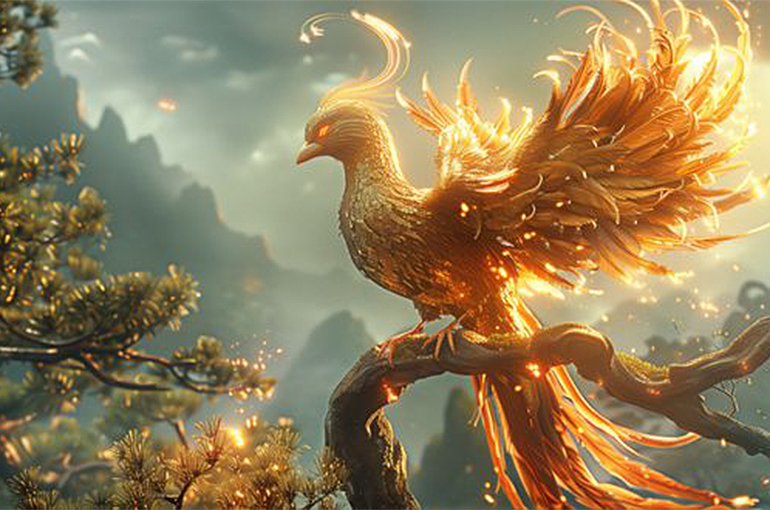
Official still introducing AI mini-dramas from Douyin and Kuaishou. Image: Yicai Global.
The production used Dreamina (即梦), ByteDance’s AI creative platform, strengthening directorial control in video generation, including horizontal and vertical camera movement. Rather than merely “explaining” cultural heritage, it is a notable example of using AI visuals to let audiences experience it as a story.
3. Strange Mirror of Mountains and Seas: Travel Through Waves (山海奇镜之劈波斩浪) — Mythic action that reached 7.5 million views
A five-episode AI micro-drama released by Kuaishou in July 2024. Based on the ancient Chinese geographic and mythological text Classic of Mountains and Seas, it portrays fantastical creatures and a world of adventure.
Reportedly reaching around 7.5 million views soon after release, it showed that AI video had become entertainment competing for audience numbers, rather than simply a technical demonstration. Humans handled the first script draft and final editing, while AI streamlined cinematography, art direction, costumes, lighting, and other processes. Its production cost was reportedly less than one-quarter that of a conventional production.
4. Hero — An ordinary man joins Huo Qubing across time
An AI short drama released by CCTV in June 2024. It is a coming-of-age story in which an ordinary modern man travels through time and fights alongside Huo Qubing, the renowned general of the Western Han dynasty.
AI is used for the portrayal and emotional expression of historical figures, as well as sweeping battlefields and fantastical spaces. Rather than relying solely on actors to recreate real-life heroes, the work attempts to depict them as new kinds of screen characters, making it an intriguing exploration of the fit between historical drama and AI.
5. Love Never Ends (爱永无终止) — A family drama combining AI and live-action actors
Also released by CCTV in June 2024, this micro-drama combines AI with live action. It tells a three-generation family story in which a young person recreates their deceased father with AI in an effort to comfort their grandmother.
While centering actors’ performances, it uses AI to generate imagined visuals and fantasy scenes. Rather than generating characters entirely from scratch, this “hybrid production” approach supplements human performance and suggests a practical path forward. At the same time, its theme of recreating the deceased raises questions about consent, likeness rights, and the treatment of memory.
6. Fantasy Specialty Store (奇幻专卖店) — Fully AI-generated sci-fi about future pets
A science-fiction micro-drama released by CCTV alongside Hero and Love Never Ends. Through AI-generated future people and strange animals, it explores “seeking and being sought” and “loving and being loved.”
Generated entirely with AI, it visualizes pets and future cities that do not exist in reality. By putting “beings that cannot be filmed”—a strength of generative AI—at the center of its story, the work offers an accessible demonstration of AI video’s advantages.
7. Beyond the Fables — Characters from Chinese mythology arrive in the present day
A three-episode AI micro-drama series released by international broadcaster CGTN in December 2024. It brings figures from Chinese mythology, including the White Dragon Horse from Journey to the West, into the present day to explore three themes: high-speed rail, space exploration, and green energy.
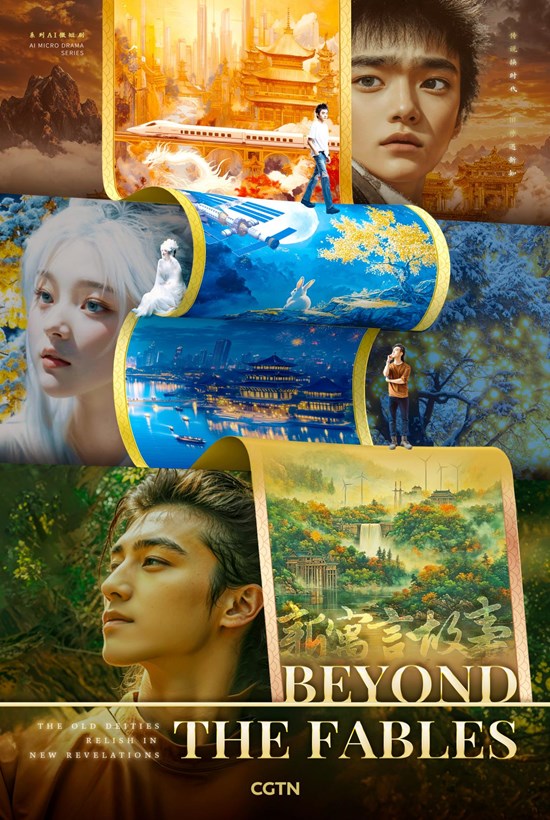
Official key visual for Beyond the Fables. Image: CGTN official announcement.
AI was introduced across a broad range of processes, from scriptwriting and visuals to audio and music. By linking mythology to introductions of future technology, it also has an aspect of “digital cultural diplomacy” aimed at sharing Chinese culture overseas. In addition to the video series, it expanded into a digital picture book and music album.
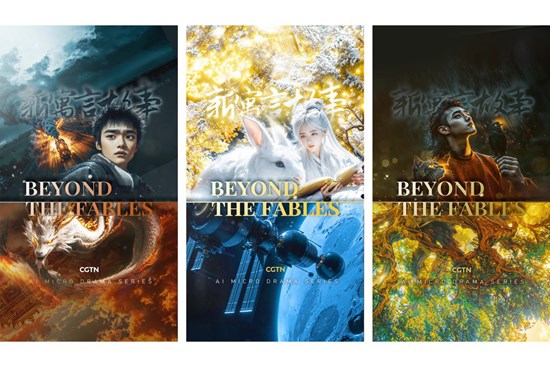
The three episodes depict transportation, space, and green energy. Image: CGTN official announcement.
8. Seeking the Truth (求真) — A public-interest micro-drama about science and combating fakes
A public-interest AIGC micro-drama series produced by Shanghai Media Group (SMG) in 2024. While using AI visuals to portray outer space and the microscopic natural world, it communicates the dangers of online scams, rumors, and misinformation.
It was distributed through Knews and BesTV, with television broadcasts also planned. In a short-drama market dominated by romance and revenge, its use of AI imagery for scientific literacy and public education is distinctive. It is also a somewhat paradoxical example: AI can create fakes, but it can also become teaching material that encourages people to be wary of them.
9. Kiss Lighting — Ghost Cupid — An AI romance from a Korean broadcaster
Outside China, Kiss Lighting — Ghost Cupid from South Korea’s SBS Medianet is a notable example. Broadcast in December 2024, this romance centers on Woo-young, a ghost who helps people find love.
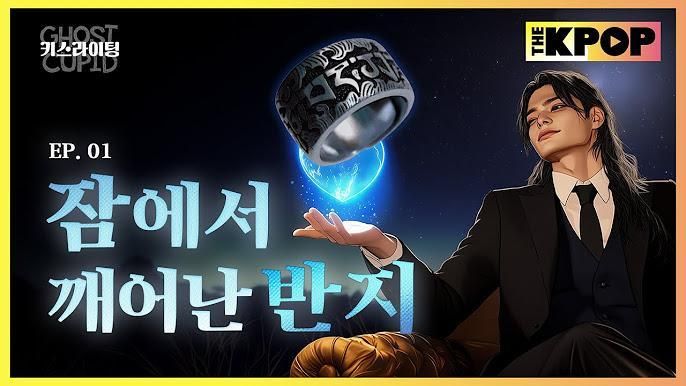
Introduction image from episode 1 of Kiss Lighting — Ghost Cupid. Image: The Korea Times and SBS Medianet’s official YouTube channel.
The director expanded an initial outline with ChatGPT, then a screenwriter produced the final draft after meetings. HeyGen, ElevenLabs, Midjourney, and other tools were used for video, audio, and visual creation. The work shows that an “AI production pipeline” combining human planning and judgment with multiple generative-AI tools is beginning to enter established television broadcasters.
10. Exit Valley — A participatory AI animation from the United States where viewers create what comes next
A satirical animation from Showrunner, the generative-AI platform developed by U.S.-based Fable Studio. Set in the fictional city of “Sim Francisco,” it takes on Silicon Valley’s AI industry and prominent tech executives.
Its defining feature is that viewers can enter text prompts to create new scenes and episodes. Rather than passively watching a completed show, viewers can participate in the story, creating branches and spin-off episodes in pursuit of “playable television.” Backing from the Amazon Alexa Fund was also reported, making it a prominent example of how AI drama could transform not only production techniques, but also viewing experiences and the nature of intellectual property.
AI drama: from “low-cost video” to new formats
Taken together, these 10 works reveal three major directions in today’s AI drama.
- Fully generated: AI builds everything, including characters, backgrounds, audio, and music
- Hybrid: AI visuals are combined with actors’ performances and human-written scripts at the core
- Participatory: Viewers generate what happens next and expand the world of the work themselves
China’s early lead in AI micro-dramas is rooted in minute-long stories, the enormous audiences of vertical-video platforms, and abundant source material in mythology and history. In short-form works, it is also comparatively easier to manage the consistency of characters and backgrounds, a common challenge for generated video.
At the same time, as the technology advances, issues such as the unauthorized use of actors’ faces and voices, copyright in training data, disclosure that content is AI-generated, and creators’ employment and compensation become more serious. Actors’ organizations in China have also raised concerns about unauthorized use, showing that the field has reached a point where it cannot be discussed solely in terms of entertainment value or lower costs.
The real test for AI drama is not whether it can produce convincing-looking images, but whether it can create characters and stories that make viewers want to watch the next episode. From 2024 to 2025, experimental works proliferated rapidly. The next question is whether enduring series will emerge from these short-lived hits.
References
- Yicai Global: CCTV Airs China’s First AI-Generated Mini-Drama
- Yicai Global: Chinese Video Sites Douyin, Kuaishou Launch AI-Generated Mini-Dramas
- The Paper: Three original AI micro-dramas from China Media Group
- CGTN announcement: Beyond the Fables
- City News Service: Public-interest micro-dramas produced with AI technology
- The Korea Times: AI revolutionizes Korean drama production
- GeekWire: Amazon Alexa Fund backs Fable
- CNA: China’s AI microdramas go viral — but spark copyright fears
Information current as of September 24, 2026. Japanese renderings of work titles in this article include provisional translations by the author.